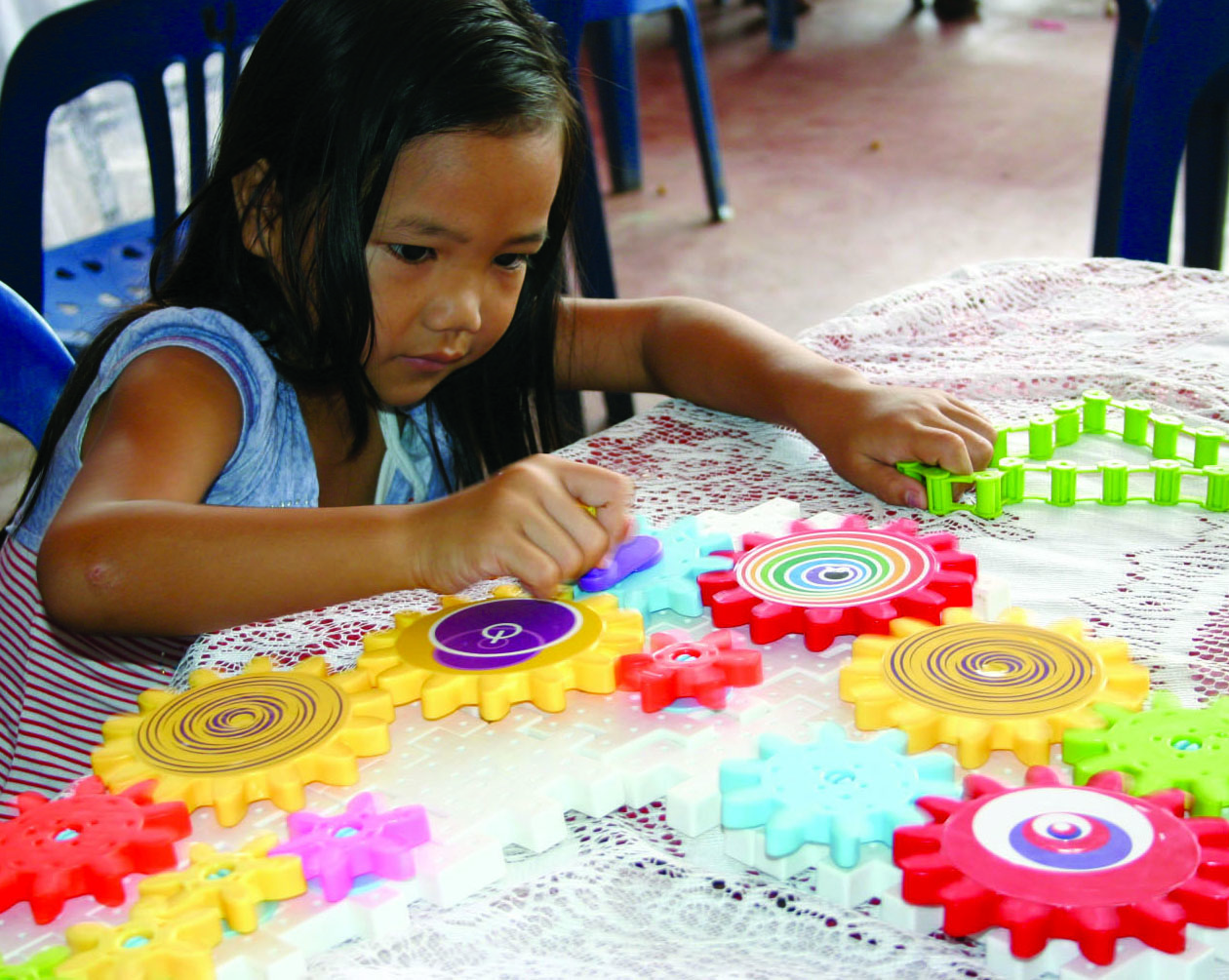
In Italian early childhood settings, play is not understood as the opposite of learning — it is the primary medium through which toddlers build the cognitive structures, social skills, and physical capacities that formal education later builds upon. This perspective is embedded in the national curriculum framework for the scuola dell'infanzia and is reflected in the physical design of Italian nidi, where materials are selected and arranged to invite rather than direct interaction.
What the research says about play and learning
A substantial body of developmental research, much of it reviewed in the 2018 American Academy of Pediatrics (AAP) policy statement on the importance of play, establishes that play-based learning supports executive function, language acquisition, social-emotional competence, and early mathematical reasoning simultaneously. The AAP's analysis found that structured academic instruction in the preschool years, when substituted for play, produced short-term knowledge gains that typically disappeared by age 7 and was associated with increased anxiety and reduced intrinsic motivation in some cohorts.
Italian developmental psychologist Livia Bicego has argued in her work with the Regione Friuli-Venezia Giulia's early childhood commission that the Italian term gioco libero (free play) is frequently misunderstood as passive or unproductive. In practice, free play in a well-prepared environment is characterised by high-intensity cognitive engagement: children set goals, test hypotheses, negotiate rules, repair breakdowns in social coordination, and revise strategies in real time.
The Montessori inheritance
Maria Montessori developed her method in Rome, beginning with the first Casa dei Bambini in the San Lorenzo district in 1907. Her approach remains influential in Italian early-years contexts, though it is rarely implemented in the purist form she described. Key elements that have been absorbed into mainstream Italian early-years practice include:
- Child-paced activity: children select materials from a prepared environment rather than receiving teacher-directed tasks.
- Isolation of variables: materials are designed so that one quality — weight, texture, size, sound — is varied while others remain constant, enabling children to focus attention on a single dimension.
- Three-period lessons: a naming sequence (this is X; show me X; what is this?) that moves from receptive to expressive language.
- The prepared environment: materials at child height, proportioned furniture, uncluttered spaces — conditions that reduce cognitive load and increase autonomy.
Research on Montessori outcomes in Italian settings is limited by the variation in implementation quality, but a 2017 study published in the journal Frontiers in Psychology, examining 140 children in Montessori and conventional Italian preschools, found significantly higher executive function and early literacy scores in the Montessori group at age 5.
Sensory play
Sensory play — engagement with materials that stimulate touch, smell, hearing, sight, and proprioception — is a distinct category with a strong theoretical and empirical basis. The sensory systems are primary channels of information for toddlers, who have not yet developed the symbolic abstraction that allows older children and adults to process the world primarily through language.
Materials commonly used in Italian nidi
Water tables, dry rice and pulse bins, clay, dough, sand, natural loose parts (shells, pebbles, pinecones), and fabric scraps of varied texture appear regularly in Italian nidi documentation. The Reggio Emilia approach, developed in the municipality of the same name and now internationally known, places particular emphasis on materials that carry the qualities of natural systems: irregularity, complexity, and the capacity to be transformed.
The atelier — a studio space within each Reggio school where an atelierista (art educator) works alongside children — is a formal institutional response to the proposition that materials are a language, and that children need skilled adult partners to explore what that language can express.
Outdoor and nature-based play
Outdoor play received renewed institutional attention in Italy following the COVID-19 period, during which research on restricted-play cohorts documented measurable impacts on motor development and self-regulation. The Ministero dell'Istruzione's 2022 guidance note on outdoor learning acknowledged the evidence base for what Scandinavian frameworks call friluftsliv (outdoor life) and encouraged Italian schools to extend time spent outdoors beyond the traditional ricreazione (recess) model.
Natural environments offer a category of sensory input — uneven terrain, unpredictable wind, varied light, living organisms — that indoor settings cannot replicate. Research published in Environmental Health Perspectives found that regular access to green outdoor environments was associated with attentional restoration in children aged 4–8, with effects detectable in both self-report and neuropsychological measures.
Risk and supervised challenge
A recurring theme in Italian educational discussions about outdoor play is the tension between safety — which Italian legal frameworks address in some detail — and what Norwegian researcher Ellen Sandseter calls "risky play": climbing, rough-and-tumble play, speed, height, and disappearing from adult sight. Sandseter's research, which has been replicated and extended in several European contexts, found that children who engage in supervised risky play show lower anxiety levels in adolescence than those raised in consistently risk-free environments. Italian nido coordinators interviewed in a 2021 study by the Università di Bologna described navigating this tension as one of the central professional challenges of the role.
Structured play with adult involvement
The literature distinguishes between child-initiated play, adult-initiated play, and co-constructed play, in which adult and child jointly develop an activity that neither would have arrived at independently. All three have documented developmental benefits and serve different functions.
Adult involvement in toddler play is most effective when it follows what Vygotsky termed the zone of proximal development — the space between what a child can do independently and what they can achieve with skilled support. This means the adult's role is to extend slightly beyond the child's current capability, not to demonstrate or instruct. In practice, this looks like narrating what the child is doing, posing a slightly harder version of the problem they are already working on, or introducing a new material at a moment when the child's attention is high.
Sources
- American Academy of Pediatrics – The Importance of Play in Promoting Healthy Child Development (2018)
- Reggio Children – Reggio Emilia Approach Documentation
- Ministero dell'Istruzione – Indicazioni Nazionali e nuovi scenari (2018)
- Sandseter, E.B.H. (2009). Characteristics of risky play. Journal of Adventure Education and Outdoor Learning.
- Frontiers in Psychology (2017). Montessori Preschool Elevates and Equalizes Child Outcomes.

